
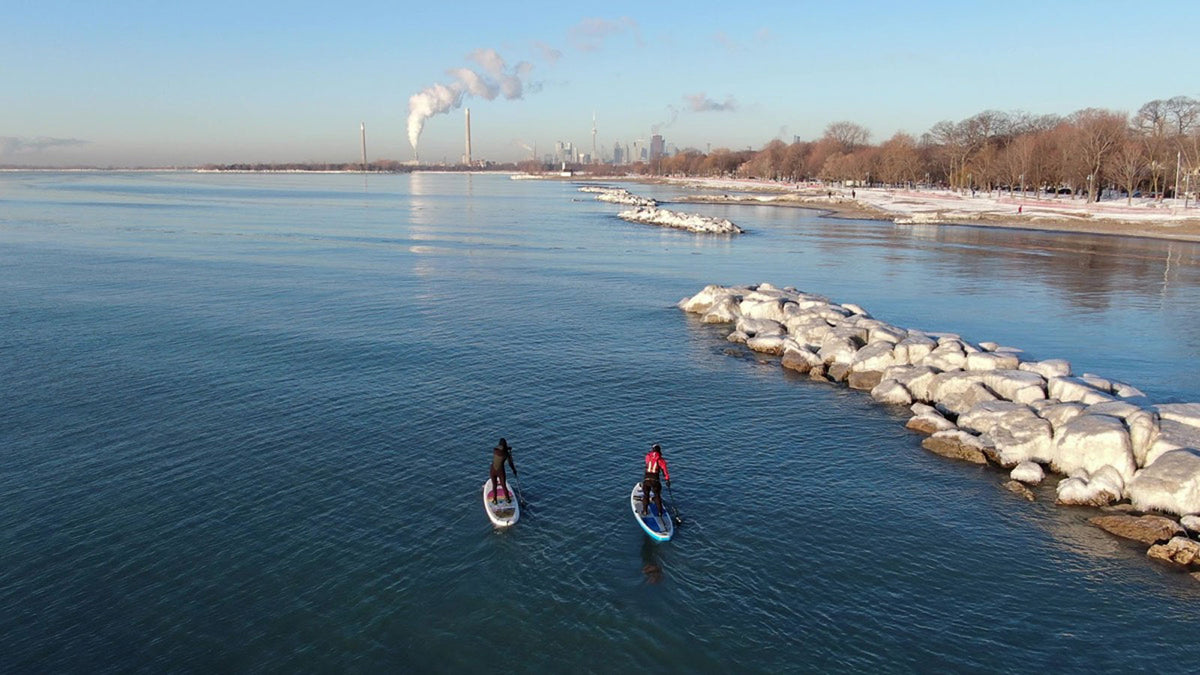
Although stand-up paddleboarding (SUP) is more commonly associated with warm weather, winter can be a wonderful time to get out. The snow, ice, and cold provide a new perspective on familiar waterways and paddle routes. Plus winter is prime surf time for all you SUP surfers out there!
It’s taken many outings to get completely comfortable with winter SUPing, but I now have my routine down. Here are a few tips for those of you thinking of taking your board out of hibernation for a flat water adventure. Just keep in mind that you should have some solid SUP skills before venturing out in the winter. This is not the ideal season for those who feel shaky or aren’t able to turn their board.

First up, you’ll want to plan your outing in advance. Find a paddle buddy (safety in numbers), pick a spot you’re familiar with, and check two things: weather and ice. If the predicted forecast calls for winds over 10 knots or extreme cold, or there’s significant ice coverage, you should wait until the conditions are ideal. There are plenty of weather and wind apps like Windy and the Weather Network. For ice on the Great Lakes, head over to the Great Lakes Environmental Research Laboratory (GLERL) for their ice map.
Gear in good working order is crucial for winter months. I lay everything out the day before and give it a once-over. Your board should be ding-free and your leash, paddle, PFD, and dry bag should be in top shape. Although a dry suit is a great (but pricey) option, a 5/4 wetsuit or thicker, paired with 7mm booties and 7mm mitts work well. For added warmth, check out Wet Sox/WORN Thermals; they provide an extra 1.5 mm of sweet, sweet neoprene. I also recommend packing an après-SUP kit consisting of warm clothes, a fully-charged phone, some snacks, and a hot beverage.

The day of your outing, give yourself plenty of time to arrive at the meeting spot and gear up. Everything and everyone moves slower in the cold. Once you get to the spot, take a look at the scene. The water should be calm and your entry and exit points should be ice free. Walking on an ice shelf is unpredictable and can be very dangerous. When in doubt, don’t go out.
Once you’re satisfied with the conditions, it’s time to get your neoprene on. You can wear your wetsuit hood for warmth, but I opt for a wool toque and will sometimes layer a light windbreaker over my wetsuit, making sure it doesn’t interfere with my life vest or PFD belt. Pack a dry bag with your cell (in case of emergencies), water, a granola bar, and car keys. If I use my Red Paddle board, then I have the extra step of pumping the board. Manually inflating a board is a great way to warm up and build heat in the body. After a few quick stretches (if you’re over thirty, you know), hop on board, leash up, and get paddling on the cold, chilly, beautiful waters.

The calm and quiet can’t be beat; I’m usually the only person on the water in the winter. There’s a stillness in the air that you won’t find during any other season. Get ready for that rush of feeling like a total cold weather rebel in a quiet, calm, magical winter wonderland. I alternate between wanting to whoop in excitement, to soaking up the meditative, watery landscape. Sunrise paddles are particularly spectacular and winter comes with the bonus of later sunrises. I’m not an early riser, so I appreciate those extra hours of sleep and the opportunity to start my crack of dawn paddle sessions later than in the warmer months.
I love paddling near rocky formations, as there’s often ice build-up that creates wonderful icy landscapes. If you are comfortable crossing from Cherry Beach to Tommy Thompson Park, you can get a unique view of the park that is not accessible by foot. You might even come across a snowy owl or two like I have. I also love being out when it’s lightly snowing, not only for the picturesque quality but also because (as any Canadian knows) snow usually means the air temp is at least zero. It’s practically tropical!

When paddling in the winter, it’s wise to be extra-mindful of your physical condition and surroundings. Check your comfort level (Are you cold? Tired? Hungry?) and the environment (Is it starting to cloud over? Are the winds picking up?). The moment there’s any issue, it's time to turn back. My feet are the first thing to start tingling with cold and therefore acts as my exit cue. It’s not always easy to turn back but it’s necessary for safety and to avoid frostbite.
Once back on shore, it’s time to start the process of warming up. Afterdrop is a real possibility, so warm up in stages. Throw on a change robe or oversized coat, remove your wet neoprene and change into warm clothes (a fleece hoodie, joggers, and wool socks are bliss). Next is a few sips of warm liquid. Then it’s time to turn on the car engine, get the heater going and drive home to a hot shower. If you haven’t had a hot shower after being out in the cold, then you are missing out. It is the sweet bonus as you thaw out, warm up and realize; you went winter SUPing. You are now a cold weather badass.
Words by Jordan-na Belle-Isle. Photographs by Matthew Arbied and Diana Lee.

Jordan-na is a Montreal-born, Toronto-based SUP instructor and lake surfer. She has been paddleboarding for over seven years and is certified with the World Paddle Association. Her SUP and surf adventures have taken her to spots in Canada, Hawaii, the continental US, and the Philippines. She has been featured in the Toronto Star and the Welland Tribune, as well as the short documentary film “In Winter.” She is also an organizer for Lake Surfistas, a grassroots group that connects and empowers women who surf the Great Lakes. Find her on Instagram.
Share:
Waterspider
Giving Voice to the Waves